11 March 2008

A Series of Things

I haven't written of any of my series e-books experiences of late and it's understandable somewhat as most of them have been workmanlike only and sometimes deathly dull. I keep abandoning and returning to one of the "Boy Allies" books, which feature two American boys in their late teens, Hal and Chester, performing miraculous missions during "the Great War" and enduring hairsbreath escapes at every turn. The boys are prodigious riflemen, athletes, and all-roung good guys and the series is so jingoistic I, ever tolerant of the old attitudes, have trouble keeping with it.

I did find and finished The Camp Fire Girls in the Maine Woods, the first of the Hildegard Frey series which introduces then-snobbish Gladys to the girls, who chiefly go by their Camp Fire nicknames: Sahwah (Sarah Brewster), the athletic girl who loves to swim; Hinpoha (Dorothy Bradford), the chubby one who is later left in the guardianship of her stuffy Aunt Phoebe; Migwan (Elsie Gardiner), the literary one who wants to attend college; Nyoda (Elizabeth Kent), their "den mother," and Nakwisi, Chapa, and Medmangi (I'm not sure if we ever learn their names). Gladys always remains Gladys in the course of the books, despite her reformation. I'd love to read all of them, but only half are online at the moment.

I did find a further treat on Munsey's (formerly Blackmask.com), however: more "Ruth Fielding" and "Outdoor Girls" books, as well as pretty much the entire run of "The Moving Picture Girls." I had already read one of the MPG's books, Under the Palms, where they are in the wilds of Florida (don't laugh; Florida was chiefly tropical wilderness at the time the book was written), but am just now reading the first book and finding out how Alice and Ruth and their father Hosmer DeVere originally joined the "Comet Film Company" and came to make "parlor dramas" and other "pictures."

The first book was written in 1914 and it is striking that although the author "Laura Lee Hope" (really one of the writers in the Stratemeyer Syndicate of children's series books and of course "author" of the "Bobbsey Twins" series) comments "I presume all my readers have seen moving pictures many times..." she proceeds to describe the process of making what is now known as the "silent film," since the concept was still so new. She actually devotes an entire short chapter to the description, which shows how much has changed in moviemaking, since all the interior shots were filmed on one big stage with directors shouting out comments to the actors, and California is stated as being a place where the film companies "went on location" to get authentic backgrounds, since the early films were chiefly shot in New York and New Jersey. But then many things have changed: the DeVeres' neighbor in the next apartment, Russ Dalwood, is designing a new motion picture camera and a patent thief is after his plans. Alice visits the Dalwood apartment one day (no key necessary; there are not even locks on the doors!) and finds someone rifling through Russ' kitchen. When they tell him what happened and suggest he call the police (note portion in bold!):

"I'll think about it," agreed Russ. "Of course he hasn't really done anything yet that they could arrest him for, unless coming into our apartment without being invited is illegal, and he could wriggle out of a charge of that sort..."
Wow.

You can find more about "The Moving Picture Girls" here, and the entire site is great, also talking about Ruth Fielding, Betty Gordon, the Outdoor Girls and other older series, plus later series like Nancy Drew, the Dana Girls, Trixie Belden, etc.

There is also a blog about her reading of these series books.

06 March 2008

Library Books

• The Ghost in the Little House, William Holtz
One of the most hotly contested books in LIW fandom, Holtz's entire purpose for this book seems to be to prove that Rose Wilder Lane, a journalist, traveler and writer in her own right, was the real author of the "Little House" series and great injustice has been done not putting her names on the books. Holtz also accuses the famous Laura of being a cold, unapproachable mother.

Frankly, all this book does is convince me that Rose was a whiner who blamed all her problems on her upbringing, and I don't think that was true at all. Rose definitely was not cut out for the life of a farmer's or Midwestern businessman's wife; instead she taught herself telegraphy and did many things during her career, including writing books, traveling overseas (including to Albania, which was a dangerous place in those days), and even selling land. She married the wrong guy, later divorced him, and though professing to hate Missouri, almost always came home for a while to Mansfield and the farm her parents had struggled to create. Holtz seems to be judging Laura Ingalls Wilder as a mother against the touchy-feely attitude of the television series Little House on the Prairie, when instead she was a woman of the times: stoic in grief, sparing in her praise. Was she stubborn and sometimes unreasonable? Yes—Laura says so herself in the business about Miss Wilder and Carrie's rocking the desk in Little Town on the Prairie—and aren't we all unless we are saints like Mother Teresa?

Holtz seems more embittered than Rose about the fact that her name did not get on the "Little House" books and she was not more well known. Rose herself said she didn't want to be associated with "children's stories," although Holtz presents ample proof that Rose did heavily edit and perhaps embellish the "Little House" novels. Rose didn't whine; why should we?

• Becoming Laura Ingalls Wilder, John E. Miller
A more balanced narrative than Holtz' book, but also more pedestrian. Since Laura left few personal papers as opposed to Rose, who wrote copious letters and kept a journal, Miller must constantly rely on Rose's POV or his own conjecture, which produces a lot of minute details of what organizations and entertainments were available in Mansfield, Missouri at the time of Laura and Almanzo's life there and then a statement that "the Wilders might have attended." The narrative is drier and Miller also repeats himself on several occasions. On the other hand, there are some very revealing or funny stories here, including what happened during the Depression when a Federal worker told Almanzo Wilder he wasn't allowed to plant a crop of popcorn. (The Wilders were not fans of FDR and the New Deal.) And, unlike Holtz, Miller does not constantly refer to "blind Aunt Mary" every time he mentions Mary Ingalls, a great relief. Recommended if you don't mind the scholarly approach to biographies and if you are a fan of Laura Ingalls Wilder.

• Fans, Bloggers and Gamers, Henry Jenkins
Contains essays that Jenkins wrote about media fans and actions between the publication of his groundbreaking book Textual Poachers in 1992 and his newest book about online fandom and how it shapes today's media, Convergence Culture. These include his original "Star Trek" essay about fan fiction, his examination of the alt.tv.twin-peaks Usenet group (which I have read elsewhere and it drives me mad not being able to remember where), a commentary about gay fans' disappointment with the non-introduction of gay life in the Star Trek universe, and examination of slash fanfic. The last third of the book are his experiences defending action video games after the shootings at Columbine High School, and the book concludes with a discussion between himself and his son about different aspects of four Buffy the Vampire Slayer episodes. An enjoyable mixed bag, but I much prefer the fan-centric stories than those analyzing the nature of classifying aspects of fandom.

• Convergence Culture, Henry Jenkins
I'd love to say I adored this book, but, unlike Textual Poachers, which was about fanfiction (and other fan creations), it's not only about fans' intersection with the internet (which isn't bad; that's what it's supposed to be about), but it partially involves two shows I have absolutely no interest in, Survivor and American Idol. Jenkins makes the subjects at least interesting, and the chapter about children participating in Harry Potter fandom was quite enjoyable.

• Wait Till Next Year, Doris Kearns Goodwin
I hate baseball. But I adore this book. But then Goodwin grew up in a time when ballparks were chummy, ballplayers didn't mainline steroids to succeed, and the Brooklyn Dodgers were a neighborhood team not an inapproachable franchise. She takes you back to hot summer days where radio announcers were nearly as famous as the players they followed, the sound of strikes and crowds floating out of each window as you passed. Too, her story is about growing up in the 1950s, in the warm neighborhoods populated by local merchants, friends who played endlessly in the streets and one another's yards, her parents and sisters, and the Catholic Church. Be assured I will be adding this one to my library.

• America 1908, Jim Rasenberger
Another book I didn't buy and am sorry I didn't. Rasenberger takes us back one hundred years, to a president who was unpredictable and capricious (and sometimes hated), to great technological achievement, the military showing its might, conflicts in the sports world and between the races, obsessions with celebrities, and stunt contests on a grand scale. If it sounds similar to today, well, truly some things never change. Theodore Roosevelt, the 1908 flights of the Wright brothers, the race to "discover" the North Pole, the stunning season of the New York Giants, the Great White Fleet, the horrifying spectacle of racial injustice in Springfield, Illinois (home of Abraham Lincoln), the trial of Harry Thaw for shooting Stanford White (which had people salaciously hanging on to every word of wife Evelyn Nesbit's sexually-charged testimony), and the creation of the Model T, which would catapult Americans onto the open road, come alive in this wonderful volume. Did you know that a 1908 magazine predicted the cell phone? That in 1908 Theodore Roosevelt told his advisor Archie Butts (who later died on the Titanic) that war between Japan and the United States was inevitable? That 1908 was the first time "the ball" was dropped in Times Square on New Year's Eve? The lively narrative is a definite plus.

27 February 2008

Books Read Since February 4

• Inside the Victorian Home, Judith Flanders
Yummy nonfiction for history buffs: Flanders describes Victorian middle-class life using the rooms of a typical home as metaphors for all stages of a person's life, starting with the bedroom where a person was born, continuing through the nursery and then into the public (drawing room and parlor) and servant's areas (kitchen and scullery) of the home. Numerous diaries, novels, and other excerpts are used to illustrate life, dress, meals, social encounters, etc. Absorbing.

• The Complete Adventures of Homer Price (Homer Price/Centerburg Tales), Robert McCloskey
I was an animal lover as a child and tended to choose books in which animals were main characters, which explains why I had never read McCloskey's classic Centerburg books way back when. Homer is an average kid growing up in the midwest, where his dad runs a garage and a motel and his mom runs the accompanying restaurant; when he's not helping them out or building radios, he visits his Uncle Ulysses' lunch counter and gets involved with the odd characters around town, including the town sheriff (who's prone to Spoonerisms) and another Centerburg resident who collect string, and certain odd events, including the malfunction of his Uncle Ulysses' marvelous doughnut machine (one of Homer's most remembered stories). These stories are still very funny.

• The Master of Sunnybank, Irving Litvag
Those animal books I loved included the dog tales of Albert Payson Terhune, and as a kid I could think of nothing better than being able to write in the wonderful melodramatic voice of Terhune, with his voluble vocabulary and stirring scenes. Hundreds of Terhune fans, including the author, remember his literary voice with delight, and indeed Litvag tries to emulate it as "the Visitor," as he tags himself, wanders the desolate grounds of what was left of Sunnybank before the house was bulldozed away, and tells the story of Bert Terhune, sportsman, dog lover, traveler, and homebody (if the home was Sunnybank). Litvag is unsparing of Terhune's faults—his neglect of his daughter for his adoring but jealous wife, his temper, his prejudices—but still finds much to commend in this biography of a man who brought Lad, the magnificent collie, and his kennelmates to vivid life.

• White Night, Jim Butcher
Life continues to be busy, dangerous and often depressing for Butcher's "only practicing wizard in Chicago," Harry Dresden, who continues to instruct Molly Carpenter in his own "ways of the force," while trying to protect a group of women from an otherworldly serial killer and cope with the return of his former foster sister. Not to mention trying to figure out why his brother Thomas has been so secretive about his life lately—could it be Thomas is responsible for the killings? With the return of all your favorite characters: Mouse the temple dog, Butters the medical examiner, Bob the skull, and, of course, Murphy. Enjoy, 'cause Harry keeps on getting better and better.

• The Tale of Holly How, Susan Wittig Albert
Second in Albert's "Cottage Tales of Beatrix Potter" mystery series, a cozy that mixes missing badgers at the badger sett, the death of a shepherd, the tribulations of an orphaned child sent to live with her strict aunt and the aunt's unfriendly assistant, the appointment of a new head teacher to Sawrey School, and of course all the inhabitants of the Sawrey villages as it becomes apparent that the death of the shepherd was no accident, and that the new head of Sawrey School isn't quite what he claims to be.

• Re-read: Little Men, Louisa May Alcott
Jo and Fritz Bhaer and their little school for boys have all been family members for years, and it's always nice to go visit again after awhile and reacquaint with the boys—and girls—of Plumfield School, especially "Naughty Nan," a wild girl who has been sent to Plumfield in hopes that Jo can teach as well as tame her, and Dan, the orphan boy who learns adults can be trusted after long trials. More didactic than Little Women, Little Men is nevertheless fun in reading about the children's pranks and plays.

• The Time Travelers, Linda Buckley-Archer
Engaging tale of a neglected boy who is visiting with the family of some friends of his au pair and who, with the eldest daughter of the family, is swept into the year 1763 after a visit to her father's laboratory and an unexpected encounter with an antigravity machine. The machine is stolen by a menacing individual called "the Tar Man," and Peter and Kate are helped by Gideon Seymour, "cutpurse and gentleman," as he styles himself, as they follow the Tar Man to London with the help of Gideon's employers, while Peter starts to see Gideon as the father figure he lacks. What could have been a trite time-travel tale is a delightful portrait of eighteenth century life (although the folks that find out about Peter's and Kate's identities seem awfully accepting awfully easy!) and a cracking good adventure story with cliffhangers around every chapter. The first book in a trilogy, it is followed by The Time Thief. Highly recommended.

• Daily Life in the United States 1920-1940, David E. Kyvig
How everyday people coped, and later survived, the boom of the 1920s and the bust of the 1930s. This is a well-narrated text, but definitely a scholarly approach; if you are looking of the friendliness of the Victorian Home text, it will be less apparent here. Nevertheless, I found it enjoyable.

• The Sweet Far Thing, Libba Bray
The conclusion of Libba Bray's Gemma Doyle trilogy, it's raised many hackles in the teenage swooning community because Gemma doesn't get the romantic ending everyone wanted for her. While Gemma struggles to know who to trust with the magic that has been endowed to her, conflicts break out between the gypsy camp nearby and the workers restoring the school's East Wing and the girls puzzle why the restoration is suddenly happening now, when the wing has been lying ruined for twenty years. At the same time, Felicity braves the peculiarities of society to earn her inheritance and independence and Ann sees a way out from her dismal future as governess to her cousin's bratty daughters. Pippa returns, a secret is revealed, and Kartik's fate is sealed in 800 rather padded but ultimately absorbing pages.

• Re-read: Eight Cousins, Louisa May Alcott
My favorite of all the Alcotts, despite its little preachments: orphaned Rose comes to live at the "aunt hill," the house in which her father was born and around which all her relatives live. She is depressed, unhealthy, and terrified of many things when her Uncle Alec, her legal guardian and once a suitor for her mother's hand, takes over her upbringing. He encourages her to get fresh air, exercise, not overstudy, learn "womanly crafts" along with French, and to explore new things, including friendship with her seven male cousins, aged seventeen to seven. The boys are a fun lot and Rose eventually blooms in their company, as well as helping them over their own problems, while providing a sisterly shoulder for the servant girl, Phebe, she "adopts" as her companion. Rose's new life always sounded like such fun, and I adored Mac, the bookworm of the boys, naturally my favorite!

• An Incomplete Revenge, Jacqueline Winspear
It's 1931, with the worldwide depression affecting England more and more, and once again time for hop picking in the south of England. Hundreds of Londoners, including Billy Beale and his family, leave "the Smoke" of London to earn extra money as hop pickers, and Maisie Dobbs joins them on a job of her own: to discover why fires and thefts occur each year during the harvest in a certain village. The locals blame the gypsies that arrive each year to pick hops, but Maisie finds the villagers unusually secretive, and a plot of ground destroyed by fire over fifteen years ago during a Zeppelin raid that gives her chilling vibrations. Another absorbing mystery/character study by Winspear, in which we learn something more about Maisie's past and find her future changing. The entire Maisie Dobbs series is highly recommended.

• A Thief in the Theater, Sarah Masters Buckey
• Traitor in Williamsburg, Elizabeth McDavid Jones
• The Runaway Friend, Kathleen Ernst
Three new "American Girls" mysteries: good if simple tales. Kit investigates theft in a community theater giving a performance of Macbeth; Felicity's father faces conviction as a traitor for helping a man so accused and she tries to help him; Kirsten (a first Kirsten mystery) tries to find out why their young homesteader neighbor suddenly disappeared, leaving the oxen he bought to be repossessed when Kirsten's father and uncle needed them for the harvest. I always enjoy these books, especially the Kit tales, but I wish they hadn't abandoned the "History Mystery" one-shots to focus on these.

• The ABC Movie of the Week Companion, Michael Karol
Imagine you order a one-pound box of chocolates, find out when it's delivered that it's only eight ounces, and then discover it half full. That's the disappointment of this tribute to the 90-minute 1970s ABC Movie of the Week, the first series of made-for-television movies. Comedies, dramas, cheesy horror stories and some downright classics, like Duel, Brian's Song, The Night Stalker, Daughter of the Mind, Tribes, Go Ask Alice, and That Certain Summer came out of ABC's movie factory for six years, along with the pilots to hit series like The Six Million Dollar Man and Get Christie Love. It needed to be lots better, with lots of photos. Still, what's here is a loving tribute to these fondly-remembered films.

• Re-read: An Old-Fashioned Girl, Louisa May Alcott
When country girl Polly Milton comes to stay a month with the rich, spoiled and discontented Fanny Shaw and her family, they cannot know how much having the pleasant, polite, plainly-raised girl around the house will mean to them. Without preaching, Polly shows them how neglectiful they are of each other, makes Grandmother Shaw's final years happy, and improves the children's relationship with their father. However, they are still a spoiled lot six years later when the story takes up its thread again with Polly earning a living at teaching music and being exposed to the little temptations shown to her by the wealthy Shaws. This isn't my favorite Alcott, but Polly is an engaging, strong heroine and some unexpected twists lead everyone to happier places.

20 February 2008

Camp Fire Girls

I was doing a search on one of my favorite old-time book series, The Camp Fire Girls (note spelling!) by Hildegard Frey, and found these links about Frey and the series:

Ohioana Library Authors: Hildegarde Gertrude Frey

The Camp Fire Girls Books: Synopses

About Frey and the Novels

06 February 2008

Some Things Never Change

I am re-reading Little Women and have come to "On the Shelf," where Meg and John argue about the children's upbringing, until John shows Meg he can manage their son gently but firmly. To make amends, Meg asks John to read to her about the election as she does a sewing project. I had to laugh at this passage:
In her secret soul, however, she decided that politics were as bad as mathematics, and that the mission of politicians seemed to be calling each other names...
I see things haven't changed at all in 140 years, even with a woman running for the office of President of the United States!

03 February 2008

Books Read Since January 16

• Hex Marks the Spot, Madalyn Alt
Third in Alt's "bewitching" mysteries about Maggie O'Neill, who becomes involved in the paranormal after she starts working at Enchantments, a small-town Indiana antiques/New Age shop, where the owner is a practicing witch. While the brutal murder of an Amish craftsman is investigated, Maggie begins to embrace her own empathic powers, as well as her mixed feelings about the two men in her life, a no-nonsense stable policeman and a leather-jacketed "bad boy." (I was quite struck by the resemblance of this relationship to that of Betty/Victor/Scott in Remember WENN—Betty is even from Indiana!) An enjoyable cozy mystery.

• Pony Farm Mystery, Pamela Kavanaugh
Most little girls love horses and ponies, although the majority of them grow out of it by the time they hit their teens. Still, even I still enjoy a good girl-and-her-horse story. Alas, this...was disappointing, to say the least: twin girls visit their recently hospitalized grandmother to help with what is left of her once flourishing horse training stable. The grandfather died after being accused of doping horses. Now mysterious and threatening things are happening on the property, but at least there's a cute boy to help the eldest twin try to solve the mystery of who set up her grandfather as she reads his diaries. The gimmick: she's always felt a strange attraction to a boy and pony statue on the property, and it seems the "spirit" of the statue is trying to help her. Despite this gimmick, the story is stale and by-the-numbers. If you want a good horse story, try National Velvet or Don Stanford's wonderful The Horsemasters.

• The Tale of Hill Top Farm, Susan Wittig Albert
If you are the police-procedural or straight detective story type, you may hate this charming cozy by the author of the China Bayles mysteries. This first book in a series revolves around Beatrix Potter, having finally made enough money from her charming little stories to buy a farm in the small village of Sawley. Beatrix brings her own little menagerie with her: a hedgehog, a mouse, and two rabbits, and parts of the story involve these creatures as well as two cats and a Jack Russell terrier who help solve the murder of a particularly prickly spinster in town. These are leisurely mysteries filled with classic British cozy-type characters. Very enjoyable reading although I found all the village folks introduced a bit hard to keep track of!

• March, Geraldine Brooks
What happened to Mr. March, father of Louisa May Alcott's Little Women, when he served in the Civil War? This is the premise of this adult flip-side novel in which March returns to a Southern plantation that he first visited as a young peddler and re-encounters a bewitching slave girl. Brooks gives this an absorbing treatment and does not soft-pedal the brutality of the period, but one wonders why she chose to parallel the Alcott novel. If she wanted to draw Alcott fans, it would have been better to avoid the numerous inconsistencies that pepper the novel, since she has chosen to make Mr. March more like the real Bronson Alcott rather than the character portrayed in the novel (the same approach Gillian Armstrong took in the latest Little Women film, which most fans found jarring). The Marches are described as vegetarians when they were not, Beth is described as sickly from babyhood when she was not, and oddest of all, "Marmee," the girls' name for their mother, is described as being Mrs. March's nickname (from her name Margaret Marie). This seemed so absurd to me that it jarred me from the narrative. (If you have ever heard the word "Mommy" spoken in a pronounced New England accent, you will understand where "Marmee" came from.) In short, some of the ties to Little Women seem overstrained. However, the narrative is otherwise good and some people may gain new insights on race relations, life, and injustices during the Civil War, although I found nothing new.

• Murder in Baker Street: New Tales of Sherlock Holmes
These were okay, if nothing special, tales of Sherlock Holmes. At times, the narratives did not sound sufficiently 19th century. My favorite part of the volume, in fact, is the chapter written by Conan Doyle himself, containing a mischievous parody of Sherlock Holmes by Peter Pan creator J.M. Barrie, plus the retrospective "100 Years of Sherlock Holmes."

• A Short History of Nearly Everything, Bill Bryson
What's your favorite thing in the entire world to indulge in? A box of chocolates? Shoes? New clothes? Computer parts? Bryson's book of science, irresistible from the first chapter to the last, is like an enormous container of every favorite thing you've ever wanted. Even if science wasn't your favorite subject in school, you will find this an immensely readable narrative of the cosmos, stars, planets, Earth, life, evolution, and finally the rise of Homo sapiens and the people who studied them. Call it "science made comprehensible," and even better, science narrative that makes you want to continue pursuing other science narratives. Like popcorn. Chocolate. Books...

• By Permission of Heaven: The True Story of the Great Fire of London, Adrian Tinniswood
Most people have heard of the Great Fire of London, begun in a baker's shop in Pudding Lane, as a minor notation in world history class quickly passed for the next battle. The ongoing English war with the Dutch, however, adds a sinister notation to the affair: was the bakery the actual cause of the fire, or was it what today what we would call terrorism? Xenophobia flourished during the fire and it was, at least at that time, eventually blamed on a "Popish plot."

This isn't my favorite period of history, so I daresay I skimmed a lot more of it than I should have. However, it's not a badly written book. Those interested in the period should enjoy it.

• Oh, Yikes! History's Grossest, Wackiest Moments, Joy Masoff
This book is just fun. I picked it up at the liquidation sale at the Discovery Channel Store at Town Center Mall. How do you get kids interested in history? Make it gross! And indeed Masoff has, concentrating on the more unsavory parts of history, like what folks did before toilet paper, monarchs who loved to kill and torture, the "nasty, brutish and short" life of Neanderthals, serfs, and outlaws, ancient medical treatments, and anything else in the past that could make a kid say "ewww." Note to prospective purchasing parents: Masoff uses a lot of potty language to keep the kids interested, including "butt" and other vocabulary of that ilk.

16 January 2008

Books Read (Excluding Christmas) Since November 14

• Fair Weather, Richard Peck
I've always enjoyed Peck's books—I read several of the Blossom Culp books after Disney adapted Child of Glass—because he seems to capture the spirit of the era he writes in (turn-of-the-century America) with little anachronism. This is the delightful, humorous story of three children who are sent to visit their aunt in Chicago during the 1893 exposition, the unconventional grandfather who accompanies them, and what happens to them at the fair.

• Timmy's in the Well, Jon Provost and Laurie Jacobsen
As a Lassie fan, I have been awaiting this book for a long time. Having read some reviews, I must say I have to agree in part with the person who wanted a lot more Lassie stories, but then this is the story of Provost, not Lassie. Provost also addresses the problems of child stars, with insights from other young actors who were his contemporaries, including Jay North, who was abused by his guardians during the tenure of Dennis the Menace, Jeanne Riley, forever branded as "bratty Margaret" on the same show, and others. He also provides some biographical data on Tommy Rettig, whom he replaced on Lassie and whom he remained friends with for the remainder of Rettig's troubled life. Provost talks frankly about his problems and relationships as his acting career dwindles, and while I felt a bit voyeristic reading about his youthful sexual exploits, I enjoyed the book.

• Sherlock Holmes: The Man and His World, H.R.F. Keating
An interesting biography of Holmes and his times through his stories. In what ways did Holmes resemble "Chinese" Gordon, the British general? How did Holmes' philosophy compare with that of Darwin? Or Oscar Wilde? What drew him to the works of Carlyle? Why was Holmes a true Victorian and never Edwardian? All these are discussed and more.

• The Forties in Pictures, Parragon Books
This is a simple bargain book of photos of the decade. Interesting, nothing special. The publisher also has a collection of photos from the 1950s and 1960s, plus books on the Beatles and Elvis Presley.

• Disney: The Ultimate Visual Guide, Dorling-Kindersley books
This volume came as a package deal with a Disney animated film (I got the new version of Robin Hood) and a collection of Mickey Mouse shorts, packaged for Costco. I have many Disney books, so almost nothing was a surprise, but there are many facts and wonderful images in this volume. It's worth having for a Disney collector.

• Mr. Monk and the Two Assistants, Lee Goldberg
What would happen to Natalie's job if Sharona ever came back? Goldberg addresses this possibility in this newest paperback offering in the Monk novel series. Sharona is back in San Francisco after leaving her husband yet again; he has been accused of murder and Sharona believes he is guilty. More to get Sharona out of her life and not endangering her job, Natalie visits Trevor in prison and after hearing his story, truly believes he is innocent. But she's going to have a job convincing Monk, since he's all aglow with the idea of having two co-assistants. Goldberg seemed to have trouble with Sharona's "voice" at first, then about midway everything clicked.

• China Bayles' Book of Days, Susan Wittig Albert
Why did I buy this, since I loathe gardening and have never read the China Bayles novels? Well, I like daybooks, and I enjoyed learning the lore of the herbs and how each has been used through history. Projects and recipes abound, good use of quotations—in short, just plain interesting. When I get through the pile, maybe I'll even give China a sample...

• Re-read: The Open Gate, Kate Seredy
I've written about this book elsewhere, so I won't bore you with the details about this story of a city family who accidentally buys a farm and learns to love living there. I first read this book in college and reading it can still take me back to the little desk in the alcove where this particular book was stored. I try to read it every year, and although I love The Good Master, The Singing Tree, and The Chestry Oak, this is my favorite of all Seredy's novels.

• Windows XP Power Hound, Preston Gralla
From the bargain rack at MicroCenter; tricks and tips with WindowsXP. Finally learned to keep all those useless things from loading and opening in Windows.

Library Books:

• Lord John and the Private Matter, Diana Gabaldon
I have only scratched the surface of Gabaldon's "Outlander" series, about a 1940s woman who is swept back in time to the Battle of Culloden and falls in love with a Scotsman, so I have no idea who Lord John Grey is in the context of the novels; he's apparently a gentleman soldier that Jamie Fraser meets in prison. While the Outlander books are historical romances, this is a historical mystery, involving Grey in the matter of a spy and stolen military secrets that coincide with Grey's investigation of a man who is going to marry his favorite niece; it appears the man is a victim of syphilis. This leads Grey to a "molly-house" (a bordello for homosexuals) and all the secrets that this lifestyle entails; Grey himself is homosexual and covering his lifestyle, knowing the danger it poses for him in 18th century society. I did find the story interesting, but the characters keep you at arm's length.

• Beany Malone, Lenora Mattingly Weber
Weber's "Beany Malone" books were standard texts for 1950s teen girls; the story of a large, loving Irish family and the growing up adventures of the youngest child, Catherine Cecilia, nicknamed "Beany." I've always loved Weber's first Katie Rose book and wanted to see what the Malone books were like. They are typical of 1950s books, with high school and college as idealistic places where the worst thing that can happen is being "cut" from a sorority rush, but Weber also addresses issues in all: in Beany it is teenage reckless driving as well as the rehabilitation of World War II veterans. If you love vintage young adult books, this is a series well worth finding.

• Laura Ingalls Wilder Country, William Anderson
I went through a Wilder urge on the last trip to the library and withdrew a total of three books; this one is an oversized picture book of photos of the people and places portrayed in the "Little House" books. Modern snapshots of the sites mix with vintage photographs; if you want to know what the real Ingalls and Wilders loved like, rather than the television version, this is the book for you.

• Laura's Album, compiled by William Anderson
This is a fascinating collection of Laura Ingalls Wilder memorabilia, including compositions done by her mother, her teaching certificate, photos of people mentioned in the books, etc.

• I Remember Laura, Stephen Hines
Hines, who "rediscovered" Laura's Missouri Ruralist essays and reprinted them as Little House in the Ozarks, has compiled this book of memories of Laura written by people who knew her. There is even an essay by a woman who was a close contemporary of her who also writes about the town of DeSmet, South Dakota. Some recipes by people who knew Laura are included. As happened in Hines' Louisa May Alcott Christmas Treasury, his introductions sometimes seem a bit over-the-top, but this is worth looking up if you are a LIW fan.

09 January 2008

What's on Your Night Table?

That to-be-read pile, which is actually on and under, and in the bookcase nearby and on the DVD case behind the sofa and even a couple still under the Christmas tree, which, yes, needs to be taken down.

First the list of those which need to be finished:
• China Bayles' Book of Days - Susan Wittig Albert
• The Gun Seller - Hugh Laurie (you can hear Laurie's voice in the narration; love it)
• Flax: Police Dog - Svend Flueron (my order from Germany; the book I read so long ago in the Arlington Library)
• Hummingbirds: My Tiny Treasures - Arnette Heidcamp
• The Adams Chronicles - Jack Shepard
• The Neandertal Enigma - James Shreeve
• American Science and Invention: A Pictorial History - Mitchell Wilson (from 1956!)
• How Was It Done - Readers Digest books (I usually love these RD coffee-table books, but finding it hard to get through this one)
• My Day - Eleanor Roosevelt
• The Outermost House - Henry Beston (classic nonfiction about Cape Cod; although it is very similar to Gladys Taber I'm struggling a bit with it)
• La Storia: Five Centuries of the Italian American Experience - Jerre Mangione and Ben Morreale
• Outlander - Diana Gabaldon
• Jane and the Unpleasantness at Scargrave Manor - Stephanie Barron (another I'm struggling through)
• The Trouble With Harriet - Dorothy Cannell (Cannell's humor comes highly recommended, but it's dull for me)
• Going to the Wars - John Verney

Books not yet begun:
• The Time Travelers - Linda Buckley-Archer
• Inside the Victorian Home - Judith Flanders
• By Permission of Heaven: the True Story of the Great Fire of London - Adrian Tinniswood
• Buffalo Bill's Wild West - R.L. Wilson with Greg Martin
• Murder in Baker Street: New Tales of Sherlock Holmes - anthology
• Corpus de Crossword - Nero Blanc (one from the dollar spinner at Dollar General)
• The Sunken Sailor - novel by 14 mystery novelists (ditto)
• The Tale of Hill Top Farm - Susan Wittig Albert (the first of her Beatrix Potter mysteries)
• Hex Marks the Spot - Madelyn Alt
• Animation Art - ed. Jerry Beck
• Oh, Yikes! History's Grossest, Wackiest Moments - Joy Masoff
• A Short History of Nearly Everything - Bill Bryson
• The Strictest School in the World - Howard Whitehouse
• Crime de Cocoa - Joanna Carl (compilation of three of her chocolate mysteries plus a short story)
• Road Trips USA: Cross Country Adventures on America's Two-Lane Highways
• Jonathan Strange and Mr. Norrell - Susanna Clarke
• Murphy's Gambit - Syne Mitchell (SF novel I picked up in our breakroom "freebee" pile)

The Christmas books:
• The War - Geoffrey Ward and Ken Burns
• London Then and Now
• Matt and Shari: Great Weekend Projects - Shari Hiller and Matt Fox

And also a couple of James's books that I'm interested in:
• Moondust - Andrew Smith
• World War II: A Day-by-Day History

30 December 2007

An Extraordinary Woman

• Maisie Dobbs
• Birds of a Feather
• Pardonable Lies
• Messengers of Truth

by Jacqueline Winspear

I owe my first purchase of a Maisie Dobbs book to a book blog; I know not which one, although I believe it is Dani Torres'. Whomever it was, I owe them thanks. I wasn't forty pages into it when I said, "I have got to buy the rest of these." Once a day, with precious 30 percent off coupons at Borders, I bought each of the rest, and when I reached the halfway point in the fourth book, I came to the sad realization that I was almost finished with Maisie's saga so far and I didn't want to let her go.

Maisie, the thirteen year old daughter of a costermonger, is stricken with another blow after her beloved mother dies: her father cannot afford to continue her schooling. The intelligent girl instead goes into service in the home of Lady Rowan, who is in favor of progressive education. Finding Maisie studying in her library early in the morning before her chores commence, Lady Rowan arranges Maisie to be tutored by Maurice Blanche, who teaches her using the Socratic method. Maisie eventually qualifies for Cambridge, where she studies until World War I breaks out; she then becomes a nurse and, on the battlefront, falls in love with one of the doctors. But disaster strikes, and a postwar Maisie is at loose ends—until she opens an investigative agency. For an assistant, she hires working class Billy Beale, originally the caretaker of the building in which she leases office space.

Each of the Maisie Dobbs stories involves some repercussion from World War I in postwar England and each are absorbing character studies as well as mysteries; they slightly remind me of Dorothy Sayers in the detail of everyday life in 1920s London and environs, and there is also an echo of Anne Perry's Reavley family mysteries (No Graves as Yet) that take place during the war.

The biggest problem with Maisie? The next book isn't out until February! It is one I will be purchasing in hardback.

29 November 2007

On Main Street

The lives of ten year old Flora Northrup and her eight year old sister Ruby change abruptly one night in January when they go out with their parents for ice cream: a car accident robs them of their parents. Their kindly grandmother Min lives with them for the remainder of the year, then sells their home and packs them up, bag, baggage and their beloved cat King Comma to the little Massachusetts town of Camden Falls, where Min and her partner Mrs. Walter own "Needle and Thread," a sewing/stitchery store on Camden Falls' main street.

Soon Flora and Ruby are ensconced at Min's home, one of the historic Row Houses a block away from Needle and Thread. Through summer visits, they are already friends with Mrs. Walter's granddaughter, Olivia, a budding naturalist who skipped a grade and who is in Flora's class. In the course of the first book, they also make friends with Nikki Sherman, a generally shunned girl who wears old clothing and sometimes cannot bathe everyday. Nikki tries her best, but her father is an alcoholic and a "mean drunk" at that, who terrorizes her, her mother, older brother, and younger sister, and her mom, as a way to cope, also drinks.

This is the premise of the "Main Street" books by Ann M. Martin, who is well-know for the "Babysitters Club" book series. While I never had any interest in the latter, the first three books in the "Main Street" series sounded appealing as a counterpart to the almost idealized Callahan Cousins books. Both feature brisk grandmother characters, but Min—who loses her temper and occasionally is cross—is much more realistic than Grandmother Gee, and the novels are a little less fairy-tale: the girls have to do chores, help out at the store, and there is no fairy-tale ending for Nikki, whose alcoholic father is simply a fact of life (although one wonders if there is no children's protective agency in Camden Falls). The stories are simple enough for tween kids, but the neighbor characters are intriguing even for those older: a Downs Syndrome teenager who is about to graduate from his special school and take his place in the working world, an older gentleman who realizes his memory is beginning to fail and who takes Olivia into his confidence, and an elderly couple who face separation when the wife develops Alzheimer's disease. Quiet Flora's struggles with grief for her mother and father contrast sharply with outgoing Ruby's seeming acceptance of the event (which Ruby carefully compartmentalizes). These are people you might meet: neighbors, co-workers, even relatives.

The books so far are:
• Welcome to Camden Falls
• Needle and Thread
• Tis the Season
and a fourth to be published in April:
• Best Friends

You may enjoy a visit to this Main Street. I certainly did.

14 November 2007

Books Read Since October 22

• Re-read: Harvest at Stillmeadow, Gladys Taber
More sketchily written than Taber's later Stillmeadow books, this covers two years of life at Taber's Connecticut home. Her children are young in this first book, so interspersed with the dog stories are amusing boy and girl stories as well.

• It's the Great Pumpkin, Charlie Brown: The Making of a Television Classic, Lee Mendelson, with Bill Melendez
Similar to the "making of" volume about A Charlie Brown Christmas, including the conception of the plot and a chapter on Vince Guaraldi's memorable score. Includes the entire script for the classic television special.

• Best Friends: The True Story of the World's Most Beloved Animal Sanctuary, Samantha Glen
I love real-life stories about veterinarians and animal rescue, so I was prepared to enjoy this. I did and I didn't. There were some great animal stories in it, but most of the stories were about the people building this sanctuary with lots of offbeat religious commentary. The author also occasionally tries to be too clever with her words, such as this cutesy-poo line from a chapter about a Hollywood fund-raiser: "Timothy Leary dazed onto the lawn." This was followed by a couple of other descriptions of this flavor. Pity, because the animals are so memorable.

• Doctor Who: The Legend Continues, Justin Richards
Coffee table book chronicling all the television adventures through the ninth Doctor and introducing the tenth. There are better episode guides but this has beautiful photos and interesting sidebars about the various reworkings of the theme, various alien species, conceptions for each new Doctor, etc.

• Re-read: National Velvet, Enid Bagnold
The ordinary Browns—well, except for Mrs. Brown—find their lives changed when their plain but horse-worshiping youngest daughter Velvet inherits five horses from a dying landowner and then wins a high-jumping piebald horse in a lottery and determines to train the undisciplined animal for England's greatest steeplechase, the Grand National. If you've only seen the Elizabeth Taylor movie, you'll find a grittier tale, with more horses (the Pi of the movie seems a combination of Sir Pericles and the Piebald), one more sister (Merry is the canary-fancier in the book and Mally the snippy one), a different past for Mi. Donald, unfortunately, is still annoying. :-) Written in unsentimental language; a glimpse of a long-gone way of life in a 1920s English village.

• Gaits of Heaven, Susan Conant
Is it me, or is Conant getting cranky? Holly Winter is apparently happily married, yet she's kvetching about her late mother. Having taken in a young woman who's overweight to rescue her from the poisonous atmosphere at home, instead of just providing shelter, food, and a shoulder to cry on, she goes on and on about the girl's obesity. (Has Conant got something against overweight people? She harps on and on, not just about it not being good for the girl's health, but more about how ugly it makes her.) Psychologists also take a beating in this book; you mean people really put up with this analyst crap as Conant portrays it? Oh, yeah, and she goes on for three pages justifying keeping her cat locked in her office because it's so unfriendly but at least she's giving it a home. Also, the asides written as "imaginings" to portray events happening away from Holly's view are really...annoying. But the dogs are still great.

• The Original Boy's Handy Book (Daniel Carter Beard) and The Original Girl's Handy Book (Lina and Adelia Belle Beard)
Both these books were written in 1887 as The American Boy's Handy Book and The American Girl's Handy Book and some time ago were reprinted in trade paper format, but I found the price then prohibitive. They have been reprinted yet again in hardback format at a better price. The boys' book, of course, covers more manly subjects like hunting and fishing, while the girls' book has the usual china painting and flower pressing, but there are surprisingly useful items in the girls' book about building items for use in the home and for public occasions. The two together are a fascinating portrait of the projects and amusements for young people of over one hundred years ago (and of the once-common items that you can't get any longer!).

• The Daring Book for Girls, Andrea J. Buchanan and Miriam Peskowitz
This is a companion book to the infamous Dangerous Book for Boys. I find both interesting, but the girls' book has too many sports entries to be satisfying. Why not more about reading or pets? The math tricks chapter is fascinating as well as useful, though.

03 November 2007

"I'd Like to Drink Color..."

Fall always reminds me of these passages from Rebecca of Sunnybrook Farm:

It was a rustly day, a scarlet and buff, yellow and carmine, bronze and crimson day. There were still many leaves on the oaks and maples, making a goodly show of red and brown and gold. The air was like sparkling cider, and every field had its heaps of yellow and russet good things to eat, all ready for the barns, the mills, and the markets...A gorgeous leaf blew into the wagon.

"Does color make you sort of dizzy?" asked Rebecca.

"No," answered Emma Jane after a long pause; "no, it don't; not a
mite."

"Perhaps dizzy isn't just the right word, but it's nearest. I'd like to eat color, and drink it, and sleep in it. If you could be a tree, which one would you choose...I'd choose to be that scarlet maple just on the edge of the pond there...I could look at all the rest of the woods, see my scarlet dress in my beautiful looking-glass, and watch all the yellow and brown trees growing upside down in the water..."


22 October 2007

Books Read Since September 12

• Mark Twain, Ron Powers
An enjoyable biography of Sam Clemens, with some facts I did not know, including the tragic, violent death of his younger brother. Powers profiles Clemens as the first media superstar and a much more complicated person than folklore portrays him.

• California Demon, Julie Kenner
• Demons are Forever, Julie Kenner
Books two and three in Julie Kenner's fantasy/mystery series about Kate Connor, former demon hunter for an organization operating out of the Vatican. Kate, whose daily adult routine had her caring for attorney/rising politician husband Stuart, teenage daughter Allie from her first marriage, and her baby son with Stuart, Timmy, has now been plunged into new demon hunting duties without Stuart's knowledge. These are fun, light reading, even with the complication of an old relationship coming to the fore in the third book.

• Kiki Strike: Inside the Shadow City, Kirsten Miller
Improbable, but amusing girls' adventure book about social misfit Ananka Fishbein, whose tenure at an exclusive private school with snobbish classmates takes an unusual turn when she notices a strange girl climbing down into a mysterious sinkhole. Ananka discovers not only a mysterious underground city, but an amazing girl named Kiki Strike who's hiding an astonishing secret, and, via Kiki, becomes part of an all-girl "strike group" consisting of other misfits.

• Shadows at the Spring Show, Lea Wait
This was a $1 acquisition from the Borders Books bargain table, a mystery involving antique print dealer and history professor Maggie Summer. Maggie is helping with a charity antique show being held to benefit an adoption group and is mystified as the next person when threatening notes demanding the show be canceled start arriving. Then one of the adoptive mothers is shot and one of her children disappears, becoming the chief suspect. I enjoyed this book, but found it nothing special. YMMV.

• If You Lived Here, I'd Know Your Name, Heather Lende
Offbeat book about life in a small Alaska town; since the author is in charge of the obituary column in the local newspaper, there are several chapters about life and death in the Northlands. The book is considerably more sober than the cute cover of a moose on a city street would have you believe.

• Sheetrock and Shellac, David Owen
Another "book for a buck," the story of Owen's adventures in DIY, starting with a renovation in a New York City apartment and then growing to a major kitchen renovation in the rural colonial home he and his wife purchased, culminating in the building of a weekend cabin at a nearby lake. Owen's narration is friendly and holds the interest, even about things as mundane as concrete and the titular sheetrock and shellac. His weekend cabin sounds like a dream come true.

• Re-read: Flicka's Friend, Mary O'Hara
I grew up near two small and ultimately mediocre libraries; fortunately my junior high school library was a goldmine of discovered classics. One of these was Mary O'Hara's Wyoming Summer, a diary of her life on the ranch that she brought to fictional life in My Friend Flicka. On the other hand, I did not know about this autobiography of O'Hara until I stumbled upon it in a used book store twenty years later. Ms. O'Hara led many lives more than the woman who brought modern ranch living to life: a pampered wealthy childhood in Pennsylvania, marriage to an arrogant politician-to-be, mother of two children, "photoplay" writer in silent movies, musician. Fascinating from beginning to end.

• In Like Flynn and Oh Danny Boy, Rhys Bowen
Fourth and fifth in Bowen's series about Molly Murphy, an Irish lass who came over to "Gaslight" New York City to escape a murder charge, who becomes, without totally meaning to, a private investigator and the apple of the eye of Daniel Sullivan, NYPD captain. I actually read Oh Danny Boy first, having forgotten to pick up a copy of Flynn. In the latter, Molly investigates two spiritualists preying on the grieving wife of a local politician and finds out her flight from Ireland was premature. In the fifth book, Molly tries to clear Daniel Sullivan of bribery charges, once again involving herself with New York gangs, the seamy side of Coney Island, and corruption in old-time New York. Sometimes the language is a bit anachronistic for the time, but Molly is so feisty and determined that it's forgivable.

• Re-read: Flambards, K.M. Peyton
I'm a big fan of the miniseries adaptation of Peyton's first three Flambards novels, but the books are jolly good reads as well. In this, the first, orphaned Christina is sent to live at her Uncle Russell's gloomy estate Flambards. Russell was crippled in a hunting accident and lives vicariously through his older son Mark, who is a fearless rider, and loathes his younger son William, who hates horses and is involved in the new science of aviation. Peyton paints a memorable portrait of Edwardian England and the changes that come during the era with lively characters.

• The World of the Golden Compass, ed. Scott Westerfield
A series of essays about Philip Pullman's His Dark Materials trilogy, examining the nature of "Dust" and Demons, heroine Lyra, and the dark adults that inhabit her world. Made me eager to go back and re-read the entire trilogy, of which the first, The Golden Compass (known as Northern Lights in Great Britain), is the best.

12 September 2007

Books Read Since August 6

• Good Morning, Heartache, Peter Duchin/John Morgan Wilson
The sequel to Blue Moon, which I also discovered in the spinner rack at Dollar General. Like his protagonist Philip Damon, a bandleader, author Peter Duchin is the son of well-known Big Band leader Eddy Duchin. This time Phil and his band are at the Ambassador Hotel in Los Angeles, where Bobby Kennedy would later be gunned down, where Phil and his band, including former black police detective Hercules Platt, are involved in the murder of their substitute trumpeter Buddy Bixby. As in the previous book, much name-dropping and run-ins with celebrities, fun if you enjoy that sort of thing. I found it easier to take this time round.

• Chow Down, Laurien Berenson
The next in Berenson's Melanie Travis mysteries finds Melanie and Sam settled into married life in their new home, and settled Melanie wants to stay, but her young son Davey secretly enters her and standard Poodle Faith in a competition to become "Spokesdog" for a new dog food. Melanie can't pull out of the competition, so she goes along with the contest, only to be embroiled when one of the contestants dies after a fall down the stairs. Enjoyable as always if you like dog-oriented cozies.

• Through Time, Andrew Cartmel
Which is subtitled "An Unauthorised and Unofficial History of Doctor Who," but should be subtitled "Andrew Cartmel's List of Episodes He Considers Notable and Why." Objective this ain't, but I found it generally amusing to read. Really, really obvious who his favorite Doctor is. :-)

• Speedbumps, Teri Garr with Henriette Mantel
A breezy, mostly easy read about actress Teri Garr's life and her growing battle with multiple sclerosis.

• Death Dines In, edited by Claudia Bishop and Dean James
Another acquisition from the $1 spinner rack at Dollar General. These compilations vary in quality; this one, mystery short stories revolving around food, wasn't half bad. There were several stories I liked more than others, including Anne Perry's "Sing a Song of Sixpence" involving Lady Vespasia, and the Alice Roosevelt story, "Alice and the Agent of the Hun." The one about the Mafia wife was pretty gross, though.

• The Chinatown Death Cloud Peril, Paul Malmont
I've read several reviews of this book that complain that the plot of this pulp-novel homage doesn't really start until halfway through the book. My opinion: who cares? The pulp era and the personalities within it—Lester Dent, the creator of Doc Savage; William Gibson, alias Maxwell Grant, the "father" of The Shadow, and a young pulp writer named Ron Hubbard (as in L. Ron Hubbard before he became "God"), not to mention E.E. "Doc" Smith, a dying H.P. Lovecraft, and a fellow calling himself Otis Driftwood (really an ex-Navy officer from Missouri invalided out of the service by tuberculosis who thinks he may go into writing)—are so much fun to read about that I was enthralled from one end to the next.

And Jacqueline Winspear's Maisie Dobbs' books, which were so good they must have a section of their own, not to mention a pile of fall-themed magazines and all the "Owly" graphic novels.

06 September 2007

I Was Off By A Decade

I had a feeling that with the passage of years American Girl's next book series would be about someone more modern: I guessed a 1964 book, but it seems they've gone post-Vietnam instead. The new American Girl is Julie, who's moving away from her Dad and her best friend Ivy after her parents' divorce to live over her Mom's San Francisco clothing store.

Meet Julie (American Girls Collection)

I was just graduating high school and then starting college in 1974, so for this to be "historical" really makes me feel old. :-)

I was really hoping the next series would be around 1914 (perhaps an immigrant girl with ties to one of the countries involved in World War I) or 1874 or 1884 with perhaps a Jewish character in the city.

(Update 09/08: Having now seen the Julie books, I must admit #5 looks interesting: she goes cross-country in a wagon train to celebrate the Bicentennial. I remember telling my father we had to go somewhere historical for vacation that year; he wouldn't go near Philadelphia, so we visited Williamsburg/Yorktown/Jamestown instead. However, having seen the covers up close, Julie looks too old to me; Molly, Kit and the others clearly look like 9-year-olds but to me Julie almost looks about thirteen. At least they have her in the correct grade, fourth, although—fourth graders had basketball teams in 1974? We didn't even have basketball in elementary school gym class in 1968, nor did the school have it after I left. Maybe California schools were different?

And having looked over the companion Ivy book, I wish she'd been the American Girl instead.)

23 August 2007

On the Callendar With John Verney

(Please note that this contains some character spoilers a few paragraphs on.)
"Daddy says that nowadays any schoolgirl of thirteen who writes a book is hailed as a genius. Well, I'm a schoolgirl and I'm nearly thirteen and though I don't think I am quite genius, I certainly wouldn't mind being hailed as one. Anyway, I've always wanted to write a book. The trouble before was that I had nothing really exciting to write one about—just school, and Friday (who is a year older) and my youngest sisters and my pony Gorse and my guinea pigs and what a nuisance grown-ups are. But of course those are what all the other geniuses of my age write about and I wanted mine to be a proper adventure story."
So begins John Verney's 1959 novel Friday's Tunnel, which introduces the Callendar family: father Gus (Augustus), a newspaper columnist, who is married to Jan (January), an expatriot American who was once an art student in Paris. As February narrates, they decided "to carry on this calendar joke with their children," naming the eldest boy Friday for the day he was born on. February was born on a Sunday, so they named her after the month instead, and for subsequent children, tiring of the calendar, Gus and Jan named them in alphabetical order (Abigail, known as Gail; Beryllium, known as Berry; Chrysogon, "Chrys," and Desdemona, "Des").

It's hard not to love February after that introduction, and she is a most ingenious child: horse-mad as many girls of that age, a middling scholar, and continually amused by her brother's interests. At the time Friday's Tunnel takes place, he has become greatly absorbed in tunnels and is attempting to dig one through the chalk cliff at the rear of their property, Marsh Manor, a smallholding with a converted farmhouse, barn and outbuildings, just north of Chichester. Little does guess that Friday's building project will somehow intersect with a new mineral found on a small Mediterranean island called Capria (where, coincidentally, Gus was stationed during World War II), the officious Lord Sprockett and his madcap wife, a cottage called Deans, and the holiday tutor Gus has engaged for the summer to Friday's and February's dismay, a young college student named Robin Fawcett.

Friday's Tunnel is such a cracking great adventure story, mixing politics at the time with technological secrets and untrustworthy officials, that the first sequel is just slightly a letdown: February's Road involves the family with a lesser crisis that will prove more personal: a new trunk road, partially spurred by Gus's scathing newspaper columns about the need for good highways in Britain, will clip off half of the paddock and bring traffic past Marsh Manor and ruin some of the most beautiful stretches of the South Downs. February is accused of sabotaging the bulldozers about to start the clearing process and the whole family, including new little brother Hildebrand, plus Dr. Henry and his children Adam and Sasha, who were introduced in the previous book, become involved in the convoluted land deals that follow.

The first two books are narrated by February; however, in the third a chummy third-person narration serves as the story follows both February and Gail as they become involved in a youth movement called "ismo," which gives the name to the third book of the series. The Callendars are moving to Florence, Italy, for a year in connection with Gus' job and the special tutor that is engaged to teach Italian to both February and Gail, as well as two other students at her co-ed boarding school, embroils them all—including some surprising adults!—in the "ismo" movement, which seeks to keep peace in the world. Unfortunately "ismo" has been infiltrated by unscrupulous sorts who want to use it to make money—and the combination of art rackets, idealistic students, and an uninspired narrative method makes this the dullest of the books.

And alas, poor February. Becoming involved with "ismo," however good her intentions, marked the "beginning of the end" for her intelligent, delightful character. By the time Seven Sunflower Seeds rolls around, she is now infected by know-it-all teen disease and considers all adults stupid or untrustworthy, and those younger than her but old enough to disagree with her as appropriate targets for scorn. Sasha Henry, the "brainy" girl who helps February solve the mystery in February's Road has become a miniskirt-wearing, sarcastic "dolly bird" who plays "ismo's" idealism like a game. Together they unceasingly criticize the narrator of Seven Sunflower Seeds, Berry, who is now the age of February in the first novel.

Caprium rears its head again in this fourth book, intertwined with the mystery of a retired racehorse boarding at Marsh Manor (the Callendars are back from Italy), editor John Gubbins' boffin-in-training nephew Rupert, the machinations of "ismo" (now being used for bad ends) and, once again, Lord Sprockett, not to mention a new breakfast cereal, the poems of Edward Lear, and Gus Callendar's "Mame"-like aunt Sophie and the Callendars' less-than-helpful au pair, known to the family as "Mamzel." Aunt Sophie is a delightful character, but much of the novel is given over to poor Berry trying to figure out if her little brother's illness was caused by poison in the form of caprium and being proved wrong and right and wrong again.

The final book in the series finds the Callendars having sold Marsh Manor and living in the town of Querbury, where Berry gets involved in a movement to save the town's old maltings (a real-life project of John Verney). Rupert Gubbins reappears, as do several characters from February's Road, in particular Mike Spillergun, who now hosts an offbeat television series, and Peter Blow. The maltings was founded by the Samson family, and wayfaring Samuel Samson is rumored to have a treasure, the "Hoard" of the title, fabulous Incan artifacts, hidden somewhere on his property, once the home the Callendars have purchased. In addition, Gus is running for the town council, and Verney gets some sharp jabs in about small-town politics, not to mention small-town boys made good...or did they?

Something I found interesting about this last entry in the Callendar saga is that the eldest three might as well not exist any longer: February (who was engaged to Robin Fawcett at the end of Seeds), is mentioned only as "your eldest sister," Friday is mentioned only as having once been Peter Blow's friend, and Gail might have dropped from the face of the earth! It's as if now that they're grown Verney no longer has a use for them. Dr. Henry and his family are not mentioned, either, even though Berry is sick with glandular fever during a portion of the book—she's attended by another physician altogether.

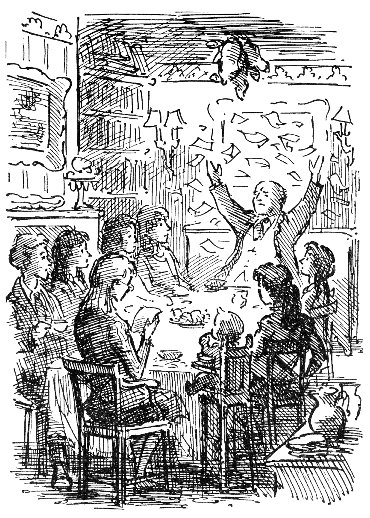
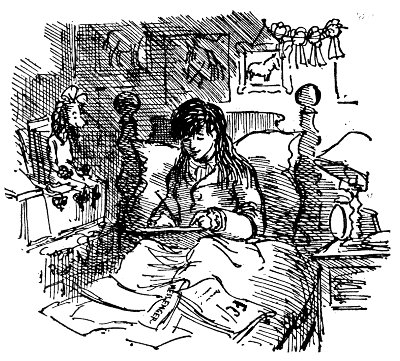
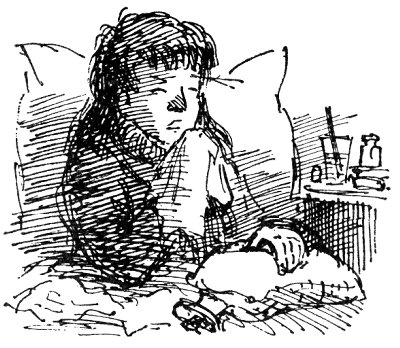
The first two books are notable for containing Verney's delightful Edward Ardizzone-like illustrations in the text (Ismo only has chapter headers and the final books only cover illustrations). Here's a few:

The family at dinner after Christmas in February's Road:

The Callendar family at table

Feb in bed after her accident in Friday's Tunnel:

February writing in her speedy scrawl

And this delightful illo of Feb with a cold from February's Road:

February sneezing

Taken as a whole they are delightful portraits of middle-class English childhood forty years ago, but Friday's Tunnel is undoubtedly the best.

I'm at present reading John Verney's World War II memoirs, which are quite offbeat compared to the more serious experiences I've been reading about (Halsey's Typhoon, etc.). It's considered a classic British war memoir.

Here's a Telegraph article commenting on Friday's Tunnel.

John Verney supported the Farnham Trust and created something called "The Dodo Pad."

06 August 2007

Books Read Since June 26

(not counting the library books...)

• Dark Tide, Stephen Puleo
In January of 1919, a huge tank of molasses in the North End of Boston burst. Although when you mention "the great molasses disaster" to people, the first reaction is amusement because it sounds so absurd, the accident killed dozens who were killed by drowning, concussion, and the force of the flow of thousands of gallons of viscous fluid. Puleo's narrative follows the lives of the families who lived and worked in the area and the repercussions of the event—and the results of the determination: was the company who owned the tank to blame? Did they ignore obvious leaks and even cover them up?

• Eric Sloane's America (comprised of American Barns & Covered Bridges, Our Vanishing Landscape, and American Yesterday)
In the 1950s Sloane did numerous books about the vanishing heritage of America: homemade tools, handmade homes and barns and bridges, and a way of life. Lovingly illustrated, wonderfully informative, and always wistful.

• Halsey's Typhoon, Bob Drury and Tom Clavin
James bought this book about a typhoon that struck Admiral Halsey's Task Force 38 in the Pacific during December of 1944. Three destroyers sank, almost 800 men were killed, and the rest of the ships survived unbelievable damage. The writing was so vivid that I was seasick halfway through the book. An amazing story of heroic efforts to stay afloat, of rescue, and of survival. The chapters about the Tabberer and her captain's efforts to keep her afloat are almost a book of their own. (One of the survivors of the storm? A young officer by the name of Gerald Ford.)

• Design for Victory: World War II on the American Home Front, William L. Bird Jr and Harry R. Rubenstein
This is the last of the books I bought in Washington, DC, last November, an overview of the posters and advertisements that were part of American life through the war years. Heavily illustrated in color.

• Another Path, Gladys Taber
Fans of Taber's Stillmeadow books will remember Taber's friend Jill who shared the farmhouse with Taber, her daughter, and Jill's children. After Jill passed away in the early 1960s, Taber wrote this short book about her efforts to come to terms with her grief. I enjoyed it, but it may be for Stillmeadow fans only.

• Re-Read: The Way It Was—1876, Suzanne Hilton
I found this book years ago, probably about 1977, for a dollar in a drugstore. It was written for young adults and told the story of life in the United States during the year of the Centennial. Hilton draws her information from diaries and news reports of the time; the book is lively and engrossing while talking about schooling, sickness, farm life and city life, and especially the excitement of the year: the Centennial Exposition in Philadelphia.

03 August 2007

Library Books

• Angels in the Gloom, Anne Perry
Third in her World War I series.

followed by

• Some Disputed Barricade and We Shall Not Sleep, the end of the series.

I gave the first book in this series a unfavorable review, but then gave the second book a chance and found it easier to swallow, with the main characters becoming more well-rounded. I actually enjoyed the last few and was of course interested to know who turned out to be "the Peacemaker."

• In Love With Norma Loquendi, William Safire
Another collection from Safire's On Language column. Didn't enjoy this one as much as the others; not sure why.

So I brought back two books to the library, looked around—and came home with six (granted, this was because this is a library that is not close to our house and I would not go there often, so I figured I'd better get them while I was there).

• Aliens in the Backyard: Plant and Animal Imports into America, John Leland
Absolutely fascinating book about...well, title tells all. There are the obvious ones, going back before the development of the US (horses, pigs, smallpox) and afterwards (kudzu, starlings, sparrows), but also things like armadillos, bermuda grass, the potato bug, etc. Very readable and not stodgy as one might expect.

• Halloween and Other Festivals of Death and Life, Jack Santino
Essays about Hallowe'en and celebrations of that ilk and time of year. Very interesting essay on Bonfire Night in Newfoundland and also an examination of placing Hallowe'en decor on children's graves; several essays on pranking in "the good old days" (outhouses tipped, buggies put on roofs, etc.) One particular essay brought back forgotten memories: Hallowe'en noisemakers! I remember the sale of these in Woolworths and Kresges back in the early 1960s, then they vanished. It was common for the older kids who were too old for trick or treat to go out in costume with noisemakers to make a racket as well as frighten the younger children.

• Lusitania, Diane Preston
Preston does an admirable job of recreating the era, the shipboard experiences, the harrowing experiences and the aftermath of the sinking of the luxury liner by German U-boats. The bravery of the survivors who floated for hours in the cold water of the North Atlantic is particularly memorable.

The final two were interlibrary loans:

• Cyberspaces of Their Own: Female Fandoms Online, Rhiannon Bury
Bury examines two internet fandoms—the David Duchovny Estrogen Brigade and fans of Ray Kowalski (and his relationship with Benton Fraser) from Due South—with special emphasis on community and communication (and the inevitable fandom fallouts) online.

• The Democratic Genre: Fanfiction in a Literary Context, Sheenagh Pugh
Pugh takes a different tack on the subject of fan fiction, that of its literary worth. She makes excellent points in regarding well-written, well-thought out fanfiction as of the same caliber as professional sequels to classic books and television tie-in novels. (Frankly, having read both, I can tell you that there is much fanfiction better than some of these published efforts. I've tossed several Star Trek novels against the wall.) She examines five fanfiction communities revolving around Jane Austen's fiction, a British police procedural The Bill, the Horatio Hornblower films, Blake's 7, and Lord of the Rings (both novels and film), but touches on other fandoms briefly as well.

01 July 2007

"...good books are the rock and refuge. For every book is a world in itself, and if I enter into it I must share that world. Books are the daily bread of the imagination, as the sky is of the eyes. And when I enter a book I am not alone."

. . . . . Gladys Taber

25 June 2007

Books Read Since June 12

• America Celebrates, Ideals
This hardback compilation covers all holidays. The photography and essays are especially nice.

• Shamus in the Green Room, Susan Kandel
The third Cece Caruso mystery finds our heroine conducting a crash-course in the life and personality of mystery great Dashiell Hammett with a popular actor who will play "Dash" in a film. Cece is with the actor when he identifies a dead body of that of his ex-lover and of course then gets embroiled in "whodunit." More of Cece's odd friends, her growing relationship with the police detective, and an interesting mystery, but nothing truly outstanding.

• The Essential Dave Allen, Graham McCann
This isn't a biography, but some biographical data interspersed with a collection of Dave Allen's best stories. Allen's voice is very clear in this almagam taken from "Dave Allen...On Life" and his sessions on the stool from Dave Allen at Large, and, despite knowing his spoofs of the Catholic church, a surprising amount of hostility to his religious upbringing. Dave, we hardly knew ye.

• The Best Years of Our Lives, Good Old Days
Postwar memories, from returning soldiers to the baby boom. Another oversize hardback, this from the publisher of Good Old Days magazine. Many stories of doing-without-but-still-happy postwar marriages.

• Re-Read: Misty of Chincoteague, Marguerite Henry
This is still a lovely, haunting book about two children willing to work to earn the horse of their dreams, the Phantom, a wily mare who has escaped the annual "Pony Penning" event on Chincoteague Island off the coast of Virginia for the past two years. This edition includes Wesley Dennis' memorable illustrations—not just of the horses, but the ones that capture the essense of the characters: Paul and Maureen on the beach, Grandma hanging the laundry, the children and the "pully bone," plus the breathtaking sketches of wild Assateague Island.

• The Pawprints of History, Stanley Coren
Did dogs influence the course of history? Stanley Coren's book contains different episodes in history in which dogs played a part in either a good—the origial tale of Gelert; Freud's use of the original "therapy dogs"—and bad—the Spanish use of huge mastiffs to subjugate the Native population of the Americas. There are fascinating chapters about Napoleon's battles with Josephine's spoilt dogs, the development of the Pekinese as a royal Chinese symbol and how the breed survived a final massacre, Washington's hounds, Lincoln's dog Fido and more.

• Curse of the Narrows, Laura M. MacDonald
During World War I, the once moribund port of Halifax became a boom town again shipping war supplies. Just before Christmas in 1917, two ships, one carrying highly flammable explosives, collided in the harbor directly before the city. The volatile cargo exploded near a wharf, laying waste to the city and causing death and horrible injuries, plus a shock-wave engendered tsunami that destroyed and killed hundreds more. Medical crews and Red Cross representatives from Boston and other points south raced to the city, hampered by a blizzard that arose the evening of the explosion. Absolutely riveting account of the events and aftermath of this now little-known episode in North American history.

• First Friend, Katharine M. Rogers
This book can be a companion to Pawprints [above], also the history of the dog, from his shadowy domestication to the development of breeds, to his use in literature and art, and from working animal to family pet. Several of the events Rogers talks about are expanded in chapters in the Coren book, such as development of the Pekinese.

• Remembering Walt, Amy Boothe Green and Howard E. Green
If you are looking for a bio of Walt Disney, try Gabler or the others; this is mainly a photo memory book of Walt Disney, with comments by the people who knew him, from his wife and brother to the actors and animators who worked with him. The photos, some from private collections, are a delight; most I had never seen before.

18 June 2007

Book (sellers) in Review

The first wonderful thing I found out about the internet was that is was a marvelous place to buy books. I started out by finding a nearly pristine copy of Kate Seredy's The Open Gate, as well as other books I'd loved in the past, like The Green Poodles and the Windy Foot and Anne H. White novels. E-Bay was the source of most of my bound issues of St. Nicholas magazine, and I have also partaken freely of that most evil of sites, bookfinder.com and Amazon marketplace. I've bought old favorites, Christmas and other holiday books, even biographies and classics.

Today two of the three books I ordered from Amazon Marketplace last Wednesday (the other, according to an e-mail from the seller, was put into the mail today) arrived. Both of these were hardback, one in pristine condition and one with a minor amount of dustjacket wear. The two of them cost me less than $10 with the postage (in both cases the postage was more than the price of the book). The one coming in the mail is another hardback, not sure of the condition, for only 99 cents (minus the postage).

It's a funny thing about used books in that most cases suddenly the hardbacks cost less than the trade paperback or paperback published later. For instance, the 99 cent book is Puleo's Dark Tide, about the Boston molasses disaster, which I have been wanting for ages. I've been fascinated with this event since an article about its 50th anniversary appeared in the Providence Journal. [The story here.] I have checked out Marketplace copies of this book for a while. Since I want a cheap price for a good book from a seller with a good rating (I try not to buy from anyone with a rating under 98 percent), finding a good combination takes time. This time I found the paperback version for no less than $4.95. However, the cheapest hardback was at fifty cents; I opted for the one that cost a little more with a better-rated seller.

Of the two books I got today, First Friend, Katharine Rogers' book about the history of man's association with the dog, was one I have wanted since it was published, but $25 seemed a bit much. It's now out of print and did not look as if it were heading for a trade paper version, hence the Marketplace buy. The other book is called The Curse of the Narrows, another fascinating nonfiction book, this time about the 1917 disaster in Halifax, Nova Scotia, where munitions headed overseas for use in "the Great War" exploded in the harbor, killing an appalling number of people. I saw this as a special on the History Channel some time ago and figured that for $1.25, I could "read all about it."

I have to say that I wish people would do better reviews on both Amazon Marketplace and on e-Bay. "As described" and "ok" tell me nothing. I always try to give as much detail as possible and praise to the seller if really good.

The reviews that annoy me the most are the ones that give the seller a bad rating because they didn't like what was sold to them! I have seen so many of these that it's actually pathetic. It's not the seller's fault if the story on the DVD turned out to be stupid or you didn't like the book! Review their service, not the product!!! (Conversely, I also find it irritating when people review books, etc. on Amazon.com by telling everyone how fast the service was and how they would order from Amazon again. Sometimes I am unfamiliar with a product and want to read reviews of it, not reviews of Amazon's service. I guess they can't tell the difference.)

19 May 2007

Books Read Since May 15

• Autumn, Susan Branch
I adore Branch's wonderful whimsical watercolor handwritten books, but they can be pricy, which is why I scooped up this from the remainder table with glee. Poetry, recipes, minute illustrations, quotations, memories, all about the fall of the year, Thanksgiving, and Hallowe'en.

• Re-read: Up the Down Staircase, Bel Kaufman
I picked up my original copy of this book from the metal racks at Nayco, the Woolworth's knockoff that occupies the old Woolworth's on Rolfe Street in Cranston, RI (or at least it still did as late as two years ago). I had heard of the book and the movie, but thought it was a dull narrative about a schoolteacher in the inner city until I saw the clever way the tale was told, with letters, school bulletins, memos, minutes, notebooks, and the frank student suggestion box entries from the teachers and students at the fictional but all-too-real "Calvin Coolidge High School." The memorable characters are by now family: idealistic new teacher Sylvia Barrett, the wise Bea Schacter, the flippant Paul Barringer, the kids including Alice Blake, Carole Blanca, Jose Rodriguez, and of course the "Adm. Ass." himself, J.J. McHabe and troublemaker Joe Ferone.

• Take Big Bites, Linda Ellerbee
A gourmet meal and the best dessert ever, all in one book. I have Ellerbee's previous two books and this is just as delightfully written. This time it's Ellerbee's adventures around the world and within herself, whether it's befriending people in Italy or Greece or England or taking on river rapids and hiking along the Thames. She lives with gusto and it spills out in a joyous celebration in this delightful set of tales (with some soul-searching along the way). Go on, take big bites.

• Murder in Little Italy, Victoria Thompson
The next (in paperback, anyway) in Thompson's series of mysteries about Sarah Brandt, widowed midwife in the poverty-stricken areas of Victorian New York City. This time she's mixed up in a murder that develops after a supposedly premature baby is born looking full-term to an Irish girl who married into a contentious Italian family, sparking off not only a police investigation but a gang war between the Irish and the Italians. Sarah's growing romance with Frank Malloy continues to move at a glacial pace as he grows no closer looking into the death of her husband, Dr. Tom Brandt, who she married despite the disapproval of her wealthy parents. Another good look at the sad, desperate lives of the poor in the 19th century along with a perplexing mystery.

• Treasury of Easter Celebrations
An Ideals gift-book size publication with lovely photos, poetry.

• The Flight of the Silver Turtle, John Fardell
Fardell's sequel to his cracking tale, 7 Professors of the Far North, isn't quite up to its predecessor, but it's great for nonstop action in the vein of those great old kids' series like Danny Dunn, with a touch of John Verney's Callendar family stories to boot, which takes off almost immediately. Each of the kids—Sam, Zara, Ben, Marcia, and Adam—get to use his or her own particular talent to again help the adults out of a jam, which involves the mystery of a hidden secret from World War II. The novel transportation feature the children use in the first book is just so memorable that the ones featured in the sequel pale slightly in comparison. Also, the villains of this novel seem more like conventional Doctor Who-type meglomaniacs as opposed to the sinister machinations in the original, which reminded me of the sinister menace in Pullman's The Golden Compass (Northern Lights). Best of all, the children are smart but not smartass, and the adults are not stooges for the kids.

• A Time to Remember, Ideals
Nostalgic poetry and essays, with the usual lovely Ideals photography.

• The Merry Christmas Book, Ideals
As always with their annual releases, contained are lovely winter photos, filler drawings, and nostalgic or thoughtful poetry or essays. These books are meant for curling up with a fleece throw on a sofa on a chilly day, to read and sip a hot beverage.

• The New Guideposts Christmas Treasury
A Guideposts collection of inspirational, thoughtful, and often amusing stories about families discovering the Christmas spirit. As far as I'm concerned, there can't be too many books that remind folks that Christmas isn't about getting big-box gifts and becoming a glutton. Even if you're not a churchgoer, these gentle stories, interspersed with poetry, recall close times with those you love.

• The Old Iron Road, David Haward Bain
In 1999, David Bain published Empire Express, a history of the building of the United States' first transcontinental railroad. He then took his wife and two children on a 7,000 mile automobile odyssey, following the route of the railroad (with several detours in Nevada) and the old Lincoln Highway, from Kansas City to San Francisco. This is the engaging detail-crammed story of that trip. Bain mixes history, trivia, Old West personalities, pioneer tales, landscapes, fellow history buffs, railroading—not to mention the story of the family trip—in marvelous detail. Along the way they visit museums, ghost towns, old railroad cuts, scenes of triumph and scenes of disaster: Promontory Point, Donner Lake, the track of the Humboldt (which Alistair Cooke so movingly described in one sequence of America) and more. Maybe a bit of my fondness for this narrative is due to the two cross-country trips I took with my parents in the 1970s (although we stuck to the interstate and didn't visit any of the fascinating places Bain talks about) as I recall those majestic or forbidding landscapes we traversed in our own car.